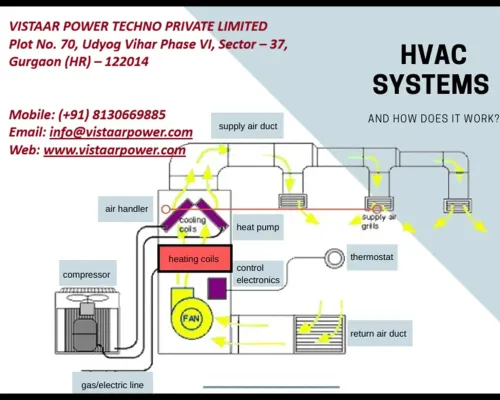
HVAC – Heating, Ventilation and Air Conditioning HVAC stands for Heating, Ventilation and Air Conditioning. It is a complete system used to control the temperature, humidity, air movement, ventilation and indoor air quality of a building or industrial facility. HVAC systems are widely used in residential buildings, offices, commercial complexes, hospitals, hotels, shopping malls, airports, factories, warehouses, laboratories, data centres and other facilities where controlled environmental conditions are required. The primary purpose of an HVAC system is to provide a comfortable, safe and suitable indoor environment while maintaining proper air circulation and ventilation. The term HVAC consists of three main functions: heating, ventilation and air conditioning. Heating is used to increase the temperature of an indoor area when the surrounding temperature is low. Heating can be provided through electric heaters, boilers, hot-water systems, steam systems or heat pumps. Ventilation is the process of supplying fresh outside air to a building and removing stale, contaminated or unwanted indoor air. Proper ventilation helps control carbon dioxide, odours, moisture, dust and other airborne contaminants. Air conditioning refers to the process of cooling and conditioning air by controlling temperature, humidity, air cleanliness and circulation. In India, air conditioning is generally associated with cooling systems, although technically air conditioning covers a wider range of environmental controls. A basic HVAC cooling system works by removing heat from an indoor space and rejecting that heat to the outside environment. In a conventional refrigeration-based air-conditioning system, the main components are the compressor, condenser, expansion device and evaporator. The compressor compresses low-pressure refrigerant vapour and converts it into high-pressure, high-temperature refrigerant gas. This hot refrigerant then moves to the condenser, where heat is rejected to the surrounding air or cooling water. As heat is removed, the refrigerant changes into a high-pressure liquid. It then passes through an expansion valve or another expansion device, where its pressure is reduced. The refrigerant becomes cold and moves into the evaporator. In the evaporator, it absorbs heat from the air or water that needs to be cooled. The refrigerant then returns to the compressor and the cycle repeats. The compressor is an important component of a refrigeration system because it circulates the refrigerant and maintains the pressure difference required for the refrigeration cycle. Different types of compressors are used depending on the capacity and application of the HVAC system. Common types include reciprocating, scroll, screw and centrifugal compressors. Small air-conditioning systems may use scroll or reciprocating compressors, while larger commercial and industrial systems may use screw or centrifugal compressors. Proper compressor operation is essential for maintaining the required cooling capacity and system efficiency. The condenser is responsible for rejecting the heat absorbed from the building and the heat added by the compressor. In an air-cooled system, fans move outdoor air across the condenser coil to remove heat from the refrigerant. In a water-cooled system, water removes heat from the refrigerant in the condenser, and the heated condenser water is subsequently sent to a cooling tower for heat rejection. Air-cooled condensers are commonly used in split air conditioners, packaged units and air-cooled chillers, while water-cooled condenser systems are frequently used in larger commercial and industrial installations. The expansion valve controls the flow of refrigerant and reduces its pressure before it enters the evaporator. Common expansion devices include thermostatic expansion valves, electronic expansion valves and capillary tubes. The expansion process causes the refrigerant pressure and temperature to decrease, preparing it to absorb heat in the evaporator. The evaporator is the component where the actual heat absorption takes place. Air or water passes across the evaporator or cooling coil, and heat is transferred from the warmer air or water to the cold refrigerant. The cooled air or water can then be supplied to the required area. One of the major HVAC systems used in large commercial and industrial buildings is the chilled-water system. A chiller is equipment that removes heat from water and produces chilled water, which is then circulated throughout the building. The chilled water is generally supplied to air handling units or fan coil units.

Gurugram
08048042133
+918802906862
 Chat with us
 Chat with us