Gurugram
08048042133
+918802906862
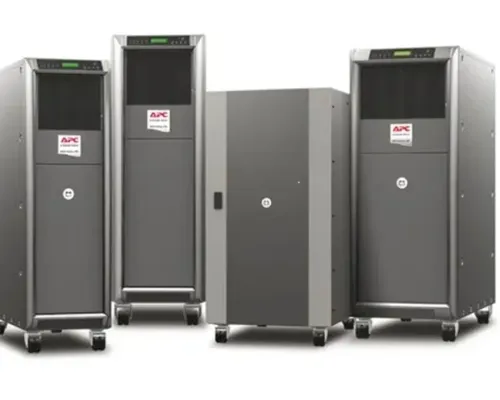
UPS System Vertiv

Liebert-ITA-Family- 6kVA-40kVA

In stock•cod not available
Phone Number

08048042133

Please keep 0 before dialling the number.

Email Address sales@vistaarpower.com

Mon-Thu: 10 AM - 2 PM • Fri: 3 PM - 7AM

Other Website Visit our other website
Address PLOT NO-70, UDYOG VIHAR PHASE -IV, SECTOR-37, GURGAON

Gurugram, India, 122015

Description

UPS System VertivLiebert-ITA-Family- 6kVA-40kVA In today's dynamic world, it is not enough for enterprises to have basic power protection. With digital trends constantly emerging and transforming the way you do business, business continuity is all the more vital

Keywords

Other Products

view all

6814772a5d263414004dd4a4 Card 2

product image
Schneider UPS

Schneider Electric UPS (Uninterruptible Power Supply) is a power protection system that provides backup power to electrical and electronic equipment when the main power supply fails. Schneider Electric offers UPS systems designed to protect computers, servers, data centers, industrial equipment, and other critical systems from power interruptions, voltage fluctuations, and electrical disturbances. A Schneider UPS normally uses batteries to supply power during an outage, giving users enough time to safely shut down equipment or continue operating until the main power is restored. Its UPS solutions are widely used because they provide reliable power backup, protection, monitoring, and efficient power management for both small and large installations. Schneider Electric is one of the world's leading companies in energy management and industrial automation. The company provides a wide range of electrical and digital solutions for homes, buildings, industries, data centers, and other critical infrastructure. One of its important product categories is the Uninterruptible Power Supply, commonly known as a UPS. A UPS is an electrical device designed to provide continuous and reliable power to connected equipment when the normal electrical supply becomes unavailable or unstable. Schneider Electric has developed UPS systems for applications ranging from personal computers and small offices to large data centers, hospitals, industrial facilities, telecommunications networks, and other critical installations. In the modern world, electricity is essential for almost every type of business and technological activity. Computers, servers, communication systems, medical equipment, industrial machines, security systems, and networking devices all depend on a stable supply of electricity. However, the electrical supply provided by the utility grid is not always perfectly reliable. Power failures, voltage fluctuations, surges, electrical noise, frequency variations, and other disturbances can occur unexpectedly. Even a very short interruption can cause serious problems for sensitive electronic equipment. A computer may lose unsaved information, a server may shut down unexpectedly, industrial equipment may stop operating, and critical medical or communication systems may be affected. A UPS helps prevent these problems by providing an alternative source of power and by protecting connected equipment from many common electrical disturbances. Schneider Electric's UPS portfolio is particularly important because it combines power backup with power protection, monitoring, energy efficiency, and digital management. The company's UPS products are available in different capacities and configurations, allowing organizations to select a system according to their power requirements and the importance of the connected load. Schneider Electric is also well known for its APC brand, which offers UPS products for home users, offices, IT infrastructure, and data centers. Through these solutions, Schneider Electric helps organizations maintain business continuity and protect critical electrical and electronic equipment. A typical UPS contains batteries, power electronics, control circuits, and protective components. During normal operation, the UPS receives electricity from the utility supply and provides power to the connected equipment. At the same time, it keeps its internal batteries charged. If the utility power fails or goes outside an acceptable range, the UPS changes to battery operation and continues supplying electricity to the connected equipment. Depending on the type and capacity of the UPS, the battery may provide power for a few minutes or considerably longer. The main purpose of a UPS is not simply to provide backup electricity. It also helps protect equipment from electrical problems. Depending on its design and operating mode, a UPS can protect against power outages, voltage sags, voltage surges, electrical noise, frequency variations, and other disturbances. Some advanced UPS systems also provide detailed information about energy consumption, battery condition, load level, operating status, and system health.

6814772a5d263414004dd4a4 Card 2

product image
Solar System

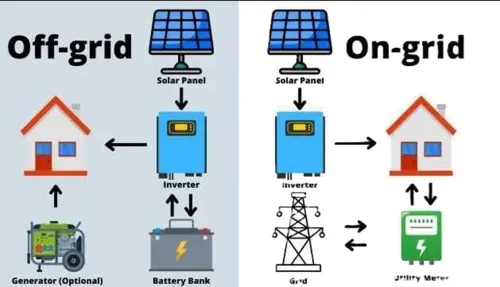
Vistaar Power Techno Private Limited provides complete solar power solutions for commercial, industrial, institutional, and residential applications. We offer end-to-end services including system design, engineering, supply, installation, testing, commissioning, maintenance, and AMC for On-Grid, Off-Grid, and Hybrid Solar Power Systems. Our solar solutions are designed to utilize renewable solar energy efficiently while helping customers reduce dependence on conventional electricity and optimize energy costs. In an On-Grid Solar System, solar power works along with the utility grid to meet the electrical requirements of the facility, while an Off-Grid Solar System uses solar panels and battery storage to provide power where grid supply is unavailable or unreliable. Hybrid Solar Systems combine solar energy, battery storage, and grid power to provide greater flexibility and backup capability, subject to the system design. Vistaar also provides preventive maintenance, performance monitoring, inspection, troubleshooting, and repair services to help maintain reliable solar system performance. With our integrated approach to solar design, installation, and after-sales service, Vistaar Power Techno Private Limited supports customers with dependable and efficient solar energy solutions tailored to their specific power requirements.

6814772a5d263414004dd4a4 Card 2

product image
HVAC

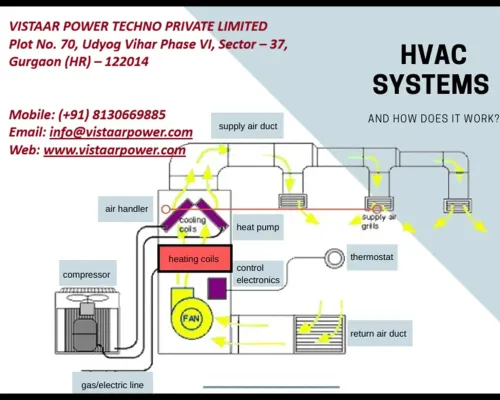
HVAC – Heating, Ventilation and Air Conditioning HVAC stands for Heating, Ventilation and Air Conditioning. It is a complete system used to control the temperature, humidity, air movement, ventilation and indoor air quality of a building or industrial facility. HVAC systems are widely used in residential buildings, offices, commercial complexes, hospitals, hotels, shopping malls, airports, factories, warehouses, laboratories, data centres and other facilities where controlled environmental conditions are required. The primary purpose of an HVAC system is to provide a comfortable, safe and suitable indoor environment while maintaining proper air circulation and ventilation. The term HVAC consists of three main functions: heating, ventilation and air conditioning. Heating is used to increase the temperature of an indoor area when the surrounding temperature is low. Heating can be provided through electric heaters, boilers, hot-water systems, steam systems or heat pumps. Ventilation is the process of supplying fresh outside air to a building and removing stale, contaminated or unwanted indoor air. Proper ventilation helps control carbon dioxide, odours, moisture, dust and other airborne contaminants. Air conditioning refers to the process of cooling and conditioning air by controlling temperature, humidity, air cleanliness and circulation. In India, air conditioning is generally associated with cooling systems, although technically air conditioning covers a wider range of environmental controls. A basic HVAC cooling system works by removing heat from an indoor space and rejecting that heat to the outside environment. In a conventional refrigeration-based air-conditioning system, the main components are the compressor, condenser, expansion device and evaporator. The compressor compresses low-pressure refrigerant vapour and converts it into high-pressure, high-temperature refrigerant gas. This hot refrigerant then moves to the condenser, where heat is rejected to the surrounding air or cooling water. As heat is removed, the refrigerant changes into a high-pressure liquid. It then passes through an expansion valve or another expansion device, where its pressure is reduced. The refrigerant becomes cold and moves into the evaporator. In the evaporator, it absorbs heat from the air or water that needs to be cooled. The refrigerant then returns to the compressor and the cycle repeats. The compressor is an important component of a refrigeration system because it circulates the refrigerant and maintains the pressure difference required for the refrigeration cycle. Different types of compressors are used depending on the capacity and application of the HVAC system. Common types include reciprocating, scroll, screw and centrifugal compressors. Small air-conditioning systems may use scroll or reciprocating compressors, while larger commercial and industrial systems may use screw or centrifugal compressors. Proper compressor operation is essential for maintaining the required cooling capacity and system efficiency. The condenser is responsible for rejecting the heat absorbed from the building and the heat added by the compressor. In an air-cooled system, fans move outdoor air across the condenser coil to remove heat from the refrigerant. In a water-cooled system, water removes heat from the refrigerant in the condenser, and the heated condenser water is subsequently sent to a cooling tower for heat rejection. Air-cooled condensers are commonly used in split air conditioners, packaged units and air-cooled chillers, while water-cooled condenser systems are frequently used in larger commercial and industrial installations. The expansion valve controls the flow of refrigerant and reduces its pressure before it enters the evaporator. Common expansion devices include thermostatic expansion valves, electronic expansion valves and capillary tubes. The expansion process causes the refrigerant pressure and temperature to decrease, preparing it to absorb heat in the evaporator. The evaporator is the component where the actual heat absorption takes place. Air or water passes across the evaporator or cooling coil, and heat is transferred from the warmer air or water to the cold refrigerant. The cooled air or water can then be supplied to the required area. One of the major HVAC systems used in large commercial and industrial buildings is the chilled-water system. A chiller is equipment that removes heat from water and produces chilled water, which is then circulated throughout the building. The chilled water is generally supplied to air handling units or fan coil units.